
© Proeye Communications & Security Systems 2017

Q) I am receiving signals in the C-band range which is 3.7-4.2GHz in Australia and at times the picture pixelates.
A) There can be a number of reasons which cause satellite TV picture to pixelate, and it can be related to one or more of the following:
•
The dish may not be pointed accurately or has moved slightly, causing the signal level to drop out from time to time.
•
Poorly sighted dish’s are shadowed by trees or structures. We continually identify trees to be a major cause.
•
Aeroplanes can cause signal to drop momentarily. However more sever pixealtion can occur if the dish is pointed accurately or the dish is undersized.
•
Faulty LNBF’s, I have had to replace faulty LNBF's which were not operating correctly any more.
•
Wireless telecommunications services causing interference to typical wideband or poorly designed LNBF’s. Wideband LNBF’s which
have an input range of 3.4-4.2GHz. are more susceptible to interference from the increasing number of telecommunications
services using the 3GHz spectrum. Suitable 3.7-4.2GHz LNBF’s are required to resolve most interference issues.
•
Some types of interference signals within the 3.7-4.2 GHz range and can be resolved by relocation the dish.
•
Faulty connectors and cables can cause pixelation.
•
Water ingress in cables due to poor installation practices. Poor installed Ku band dish installation and using electrical tape
to seal the F-connector at the LNBF. Electrical tape is not suitable and will cause water to penetrate into the cable.
•
Adjacent satellite broadcast interference. Usually cause by adjacent satellites broadcasting on the same frequency.
•
Adjacent satellite broadcast interference also is caused by reception of satellites near the horizon located from 74 to 90 Degrees E such as Apstar 7.
Q) Why are other transmitters allowed to cause interference to my satellite reception?
A) There can be a number of reasons, below lists some:
•
Local telecommunications services can be licensed to operate on adjacent frequencies or within the satellite C-band spectrum which ranges from
3.7 to 4.2 GHz in Australia.
•
Services include WiMax and point to point radio links. These local services can cause harmful interference to C-band satellite receiving systems which in most
situations can be resolved. If the interference is in the adjacent spectrum, for example 3.5GHz, then changing the LNBF can solve the problem.
•
Most off the shelf domestic LNBF’s use an input range of 3.4 to 4.2 GHz and amplify the signal from 60 to 65 dB or approximately by a factor of 1 to 2 million.
Therefore the signal from a local transmitter service operating at 3.5 GHz will cause severe interference to the LNBF. To resolve the problem
the LNBF should be replaced with a suitable LNB or LNBF that uses the correct input range of 3.7 to 4.2 GHz.
•
In some cases the signal from the local telecommunications service is at extremely high levels. In this situation the satellite TV receiving system requires a
commercial LNB engineered to withstand these high level adjacent signals, which we have available.
•
Some satellite system use the extended C-Band range of 3.4 - 3.7 GHz, such as Vinasat-1. These frequencies are outside the normal C-Band range and subject
to a higher degree of risk from wireless broadband services.
•
In some cases the signal received may be too week or fortuitous. We have seen many client satellite TV installations using a 2.3 meter dish to receive
the Vietnamese TV broadcast, on Vinasat-1, however a 3 meter dish is required for more reliable reception to to very low signal level.
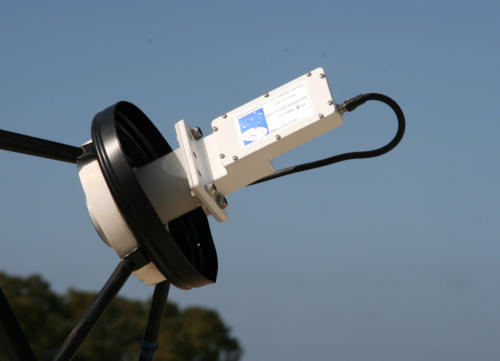
The photo below illustrates a real example of a commercial LNB we applied to resolve extremely high levels of interfering signals caused by a local
WiMax service at 3.5GHz at Werribee Victoria. The installation of the LNB also dramatically improved the received signal quality as it uses high ended components
with lower thermal noise and much better design, to perform well in the harsh Australian environment.
Satellite interference Q & A
Diagnostic Service
We provide diagnostic service to identify and resolve satellite reception interference issues.
If your satellite or TV picture often pixelates and you cannot resolve it,
contact us and we may be able to resolve it for you!
Satellite Interference
information
Communications Day,
issue 3035, Satcom,
broadcast & 3G lobbies
slam ACMA wireless
broadband proposals
SatMagazine, Satellite and
WiMax
Asia-Pacific Telecommunity
Fixed Satellite service and
WiMax coexistance
ITU Speech Houlin Zhao
ITU Dep Secretary-General
CASBAA Satellite Industry
Forum 2009